

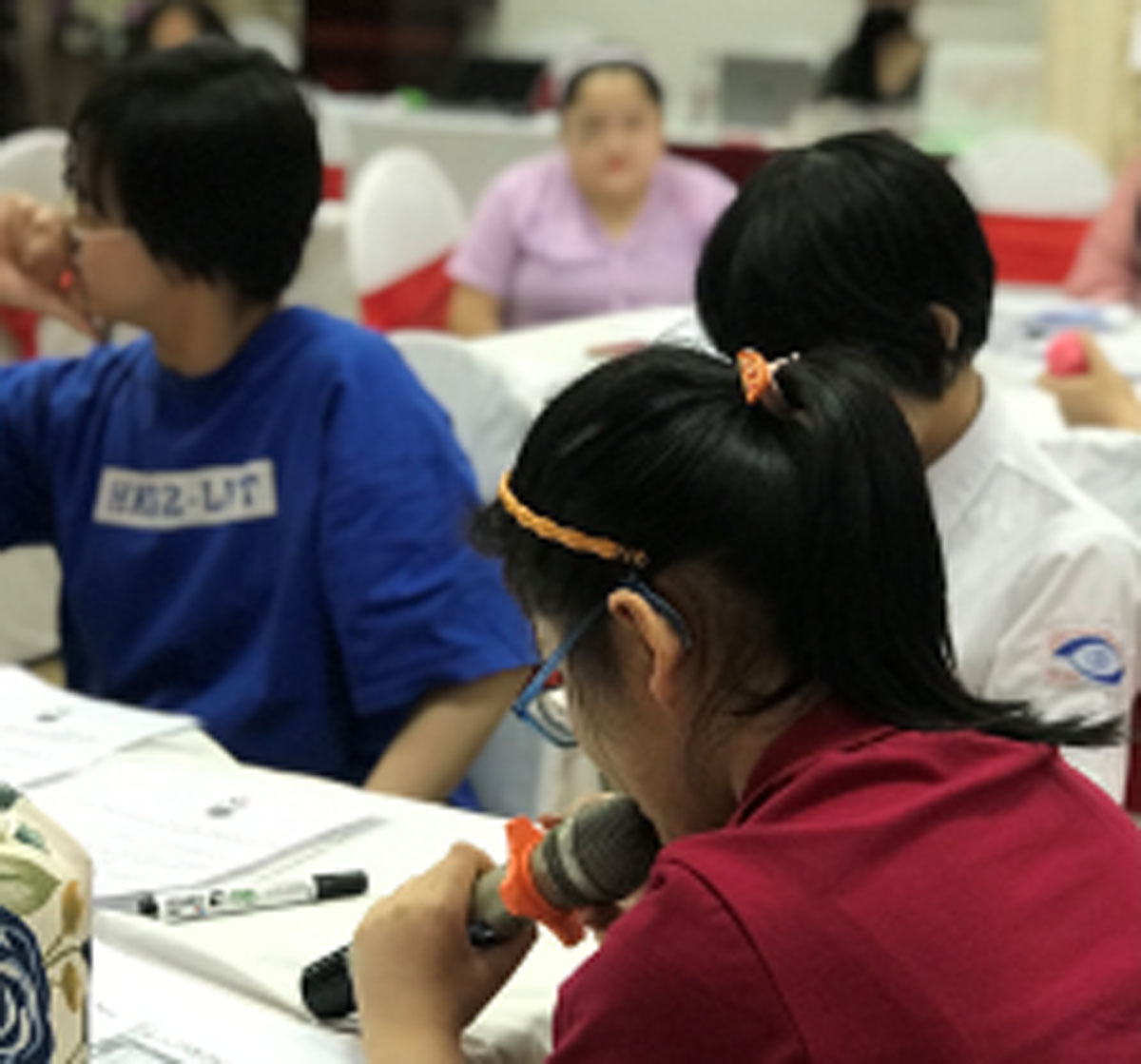
The Vietnam team is examining the participation of women and girls with disabilities in mobilizing disability rights, with a specific focus on gender equality and governance.
This research will identify barriers to participation and the roots of marginalization for some girls and women with disabilities, recognizing their diverse experience regarding disabilities, class, gender, and ethnicity. The project will also identify types of change needed for the participation of diverse women and girls with disabilities in decision-making related to disability and gender equality. Finally, it will contribute to social change and foster transnational activism by creating spaces for women and girls with disabilities to mobilize their knowledge.
Key Priorities
The Vietnam team is prioritizing the following research questions:
- To what extent are women and girls with disabilities engaged in the monitoring of disability rights and gender equality?
- What socio-political spaces exist for women and girls with disabilities to participate in monitoring their rights?
- Which disabled women and girls participate, and which ones do not? Why?
- What are the systemic roots of their marginalization?
- What are some systemic barriers to their participation into governance?
- What changes are required in order to support their voices and participation into different levels of governance?
- How can diverse women and girls with disabilities effectively mobilize their knowledge and foster social change in Vietnam and transnationally?
- How do these objectives contribute to understanding the experiences of women and girls with disabilities?
Visit the Decolonial Disability Studies Collective website for more information and updates from the Vietnam team.
Key Priorities
The Vietnam team is prioritizing the following research questions:
- To what extent are women and girls with disabilities engaged in the monitoring of disability rights and gender equality?
- What socio-political spaces exist for women and girls with disabilities to participate in monitoring their rights?
- Which disabled women and girls participate, and which ones do not? Why?
- What are the systemic roots of their marginalization?
- What are some systemic barriers to their participation into governance?
- What changes are required in order to support their voices and participation into different levels of governance?
- How can diverse women and girls with disabilities effectively mobilize their knowledge and foster social change in Vietnam and transnationally?
- How do these objectives contribute to understanding the experiences of women and girls with disabilities?
Visit the Decolonial Disability Studies Collective website for more information and updates from the Vietnam team.
About Disability in Vietnam
In 2016, 6.2 million people identified as having disabilities in Vietnam, accounting for 7% of the country’s population; however, this is likely an underestimate of the true extent of disability in the country.
- Based on 2009 census data, 8.4% of women in Vietnam live with a disability.
- Just over half (50.5%) of people with disabilities in Vietnam are female.
- 44% of the population with disabilities is employed, with the overwhelming majority working the informal sector either as farmers or self-employed (87%).

An estimated 18% to 22% of people with disabilities live with poverty.
- On average, the income for people with disabilities is less than CAD $69 per month, almost 30% lower than the monthly income of people without disabilities.
About Disability in Vietnam
In 2016, 6.2 million people identified as having disabilities in Vietnam, accounting for 7% of the country’s population; however, this is likely an underestimate of the true extent of disability in the country.
- Based on 2009 census data, 8.4% of women in Vietnam live with a disability.
- Just over half (50.5%) of people with disabilities in Vietnam are female.
- 44% of the population with disabilities is employed, with the overwhelming majority working the informal sector either as farmers or self-employed (87%).
An estimated 18% to 22% of people with disabilities live with poverty.
- On average, the income for people with disabilities is less than CAD $69 per month, almost 30% lower than the monthly income of people without disabilities.
Recommended Reading
- Nguyen, Xuan Thuy, Deborah Stienstra, Marnina Gonick, Huyen Do, and Nhung Huynh. “Unsettling research versus activism: how might critical disability studies disrupt traditional research boundaries?” Disability & Society 34, no. 7-8 (2019): 1042-1061. (EDID partnership members can request access)
- Stienstra, Deborah, and Xuan Thuy Nguyen. “Opening to the Possible: Girls and Women with Disabilities Engaging in Vietnam.” In Creating Spaces of Engagement, pp. 139-160. University of Toronto Press, 2020. (EDID partnership members can request access)
Vietnam: Snapshot of Human Rights Commitments
Vietnam: Snapshot of Human Rights Commitments
Recommended Reading
- Nguyen, Xuan Thuy, Deborah Stienstra, Marnina Gonick, Huyen Do, and Nhung Huynh. “Unsettling research versus activism: how might critical disability studies disrupt traditional research boundaries?” Disability & Society 34, no. 7-8 (2019): 1042-1061. (EDID partnership members: Request access)
- Stienstra, Deborah, and Xuan Thuy Nguyen. “Opening to the Possible: Girls and Women with Disabilities Engaging in Vietnam.” In Creating Spaces of Engagement, pp. 139-160. University of Toronto Press, 2020. (EDID partnership members: Request access)
Connect with us!
EMAIL: edid-ghdi@uoguelph.ca
X/TWITTER: @edid_ghdi
BLUESKY: @edid-ghdi.bsky.social
LINKEDIN: https://www.linkedin.com/company/edid-ghdi
YOUTUBE: https://www.youtube.com/@EDID-GHDI
BLOG: https://liveworkwell.ca/category/edid-ghdi
INSTAGRAM: Coming Soon!
MAIL: Live Work Well Research Centre, University of Guelph, Attention: EDID-GHDI, 501 MacKinnon Building, 50 Stone Rd E, Guelph, Ontario, Canada N1G 2W1

Connect with us!
EMAIL: edid-ghdi@uoguelph.ca
TWITTER: @edid-ghdi
INSTAGRAM: @edid_ghdi
MAIL: Live Work Well Research Centre, University of Guelph, Attention: EDID-GHDI, 501 MacKinnon Building, 50 Stone Rd E, Guelph, Ontario, Canada N1G 2W1